Updated on June 2, 2026
Food Safety
10 min read
What are Food Hygiene Ratings? A complete guide for businesses

Food Standards Agency research revealed that 92% of UK consumers have a high awareness of the Food Hygiene Rating Scheme, which means that your business’s rating could be a primary factor in where people choose to eat.
On top of that, over 1 in 2 people (55%) now actively check a food business’s hygiene rating before visiting.
To help you keep standards high and protect your business’s reputation, we’re breaking down everything you need to know about food hygiene ratings so you can feel confident when an Environmental Health Officer visits.
What is the Food Hygiene Rating Scheme (FHRS)?
The Food Hygiene Rating Scheme (FHRS) is a national framework run by the Food Standards Agency (FSA) in partnership with local authorities. It’s designed to give your customers clear information at a glance about your business’s hygiene standards.
Before the FHRS launched, food establishments were scored by locally run rating methods, which were inconsistent, and made it difficult for customers to compare hygiene standards across different areas.
Then, in 2010, the Food Hygiene Rating Scheme created a single, transparent national standard, with the FSA aiming to reduce foodborne illness and empower consumers to make informed choices. For businesses, it created a level playing field where high standards are publicly recognised.
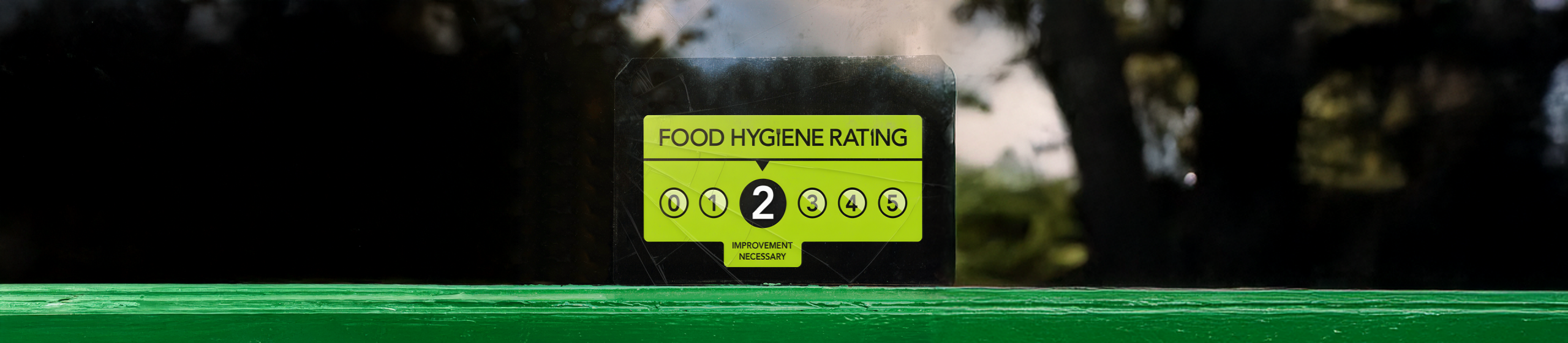
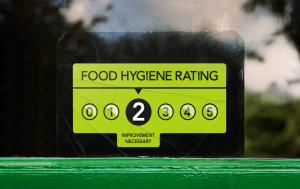
The scheme operates on a grading system, with a business’s grade presented on a green and black sticker that can be displayed on the premises and online. The local authority also publishes the rating, which is freely accessible to the public by simply searching for your business name or postcode.
Often referred to as ‘FSA ratings’ or ‘food ratings’, the scheme applies to any business that supplies food directly to consumers, including restaurants, hotels, schools, and care homes. While the scheme is standard across England, Wales, and Northern Ireland, Scotland operates under a different Food Hygiene Information Scheme.
What’s the range of food hygiene ratings?
The range of food hygiene ratings runs from 0 to 5. During an inspection, an Environmental Health Officer (EHO) assesses your premises and awards a numbered score across three specific areas. These scores are totalled and mapped to an overall rating, and the green sticker you receive reflects this score.
- 5 – Very good: Hygiene standards are very good.
- 4 – Good: Hygiene standards are good with only minor areas for improvement.
- 3 – Generally satisfactory: The business meets the minimum legal requirements, though some adjustments may be needed.
- 2 – Some improvement is necessary: There are concerns regarding facilities or handling practices that require change.
- 1 – Major improvement is necessary: A serious breach of food safety regulations has been identified.
- 0 – Urgent improvement is required: Significant, immediate improvements are needed to protect public health.
The scheme follows a lowest common denominator rule. This means that if you score poorly in just one category —even if the other two are perfect — your overall rating will be capped. This means that a business can’t average out a serious risk.
How the inspection works
When an EHO officer visits your premises to carry out assessments, they aren’t just looking at basic cleanliness. They look at your business through three specific lenses, often referred to as the three pillars of food safety.
- Hygienic food handling — This covers how food is prepared, cooked, reheated, cooled, and stored. The EHO will observe your team in action to make sure they’re following safe practices.
- Physical condition of the premises — This includes layout, cleanliness, lighting, ventilation, and pest control. They want to see that your environment is suitable for safe food production and is well-maintained.
- Management of food safety — This is usually the most critical pillar. It focuses on your documentation and paperwork, specifically your Hazard Analysis and Critical Control Point (HACCP) plan. They need to see evidence that you have a system in place to manage risks and that your staff are properly trained to follow it.
Each pillar is assigned a numerical score (0, 5, 10, 15, 20, 25, or 30), with lower scores indicating better performance.
For a deeper dive into exactly what to expect on the day, read our ultimate guide to EHO inspections.
Are there exemptions to the Food Hygiene Rating Scheme?
While the majority of food-handling businesses fall under the scope of the FHRS, there are specific exemptions. Not every business that sells food will receive a numerical rating, even though they are still required to comply with overarching food safety laws.
Exemptions often fall into two categories:
- Low-risk establishments — These are businesses that aren’t generally recognised as food businesses by consumers because they only handle low-risk, shelf-stable, or pre-packaged goods. Examples include newsagents selling only wrapped confectionery, or chemist shops selling pre-packed health foods.
- Specific care settings — Certain domestic premises used for care services, like childminders or adult care placements in a home environment, are sometimes exempt from the rating scheme.
It’s also important to note that businesses that don’t supply food directly to the final consumer, such as manufacturers, primary producers (e.g., farms), wholesalers, and distributors, aren’t rated under this scheme.
If your business is exempt, your name will still appear on the FSA website, but it will be listed as ‘Exempt’ rather than having a 0-5 score.
How often are food hygiene ratings done?
There’s no single fixed date for an inspection. Instead, the frequency of FHRS visits is determined using a risk-based system.
When an Environmental Health Officer assesses your business, they assign you a risk category based on the type of food you handle, the number of customers you serve, and your previous track record.
- High-risk businesses (like those handling raw meat or serving vulnerable groups) may be inspected every six months.
- Lower-risk businesses (like a small cafe selling only pre-packaged goods) might only see an inspector every two years.
It’s important to remember that an inspection can happen at any time, including if a member of the public makes a complaint or if there’s a significant change in your business operations. Staying inspection-ready at all times is the only way to secure your rating.
How long does a food hygiene certificate last?
A business’s food hygiene rating is valid until its next unannounced inspection, which can range from six months to two years, depending on its risk category.
This is different from a food hygiene training certificate; these are certificates held by a food establishment’s staff and don’t have a legal expiry date. However, to comply with the ‘Management of food safety’ pillar of an FHRS assessment, you must be able to demonstrate that your staff’s knowledge is current and that they’re properly supervised.
Industry best practice is to refresh Level 2 Food Safety training every three years. This means that your team’s knowledge stays up to scratch and that they’re in the know with any changes in legislation or best practices.
In short, while your hygiene rating doesn’t expire, the validity of the knowledge eventually does in the eyes of an inspector.
What are the requirements for displaying a food hygiene rating?
The rules on whether you must display your green and black sticker depends on where your business is located:
- England — Displaying the sticker is currently voluntary, though it’s highly recommended.
- Wales and Northern Ireland — It’s a legal requirement to display your hygiene rating sticker in a prominent place, such as your front door or window. Failure to do so can result in a fine.
In England, there are renewed calls to make it mandatory for businesses to display their food hygiene rating to bring it in line with the rest of the UK. From a consumer perspective, the demand for transparency is clear; our foundational Consumer Hygiene Report provided early insights into these trends, revealing that a venue’s FHR ranked among the top three key decision drivers when choosing where to eat out or order food for delivery.
Regardless of the law, transparency is almost always rewarded by consumers, and hiding a rating can often cause more reputational damage than displaying a lower one.
How to get a food hygiene rating
If you’re opening a new food business or taking over an existing one, you won’t have a hygiene rating immediately.
First, you must register your business with your local authority’s environmental health department at least 28 days before you plan to open. It’s free to register, can’t be refused, and applies to establishments like home businesses and food stalls as well as traditional restaurants and cafes.
Once you’re registered, an Environmental Health Officer will visit your premises to conduct an initial inspection and give your business its first food hygiene rating. Because this first visit determines your starting grade, it’s vital to have your processes in place from day one.
For established businesses, your rating is updated after each scheduled inspection. If you’ve recently made improvements to your hygiene standards and don’t want to wait until your next scheduled visit, you can also request a re-rating. While there’s usually a charge for this service, it means you can showcase your improved standards to your customers much sooner.
What happens if you are unhappy with your rating?
We know that receiving a hygiene rating that doesn’t reflect the high standards you strive for can be frustrating. However, the FHRS includes several safeguards to make the process fair and gives you the opportunity to improve or challenge a result.
If you believe the rating awarded by the Environmental Health Officer is unjust or doesn’t accurately reflect the conditions at the time of inspection, you have three main options:
- The right to reply — This allows you to submit an explanation via the Food Standards Agency (FSA) website. It isn’t an appeal, but rather a chance to tell your side of the story. For example, if a rating was affected by temporary issues like a burst pipe or a specific piece of equipment being out of service on the day. Your response will be published online by your local authority next to your hygiene rating.
- The appeals process — If you feel the rating is wrong or the inspection was not carried out in accordance with the law, you can lodge a formal appeal. You must do this within 21 days of being notified of your rating, including weekends and Bank Holidays. The lead officer for food safety in your local authority will then review the case.
- Requesting a re-rating — If you have addressed the actions for improvement detailed in your inspection report, you don’t have to wait for your next scheduled visit. You can apply for a re-inspection, with some local authorities in England and all in Wales and Northern Ireland charging a small fee.
Businesses can find the forms for all three options on the FSA website here.
How Food Alert can help you boost your food hygiene rating
Maintaining a high hygiene rating across your premises is serious business, but it doesn’t have to be a source of constant stress. When you have the right systems in place, an unannounced visit from an EHO becomes an opportunity to showcase your standards rather than a challenge to be feared.
Here at Food Alert, we help businesses make sure that their food safety standards are always where they need to be.
We’ve been working with foodservice and hospitality businesses for over 30 years and offer a range of services to help you stay compliant, including: